In the last issue, we introduced the concept of six-axis force/torque sensor calibration. The calibration means that the sample points of six-diamensional sample space are loaded accurately, to establish the relationship between the sensor signal and F/T, which will obtain the mathematical model and parameters of the decoupling algorithm.
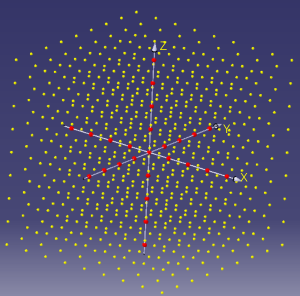
Fig.1 space of the sample points
But can the mathematical model and parameters meet the rated index of sensor performance? How is the accuracy of the sensor? These need the detection to answer it. In other words, the detection is used to evaluate whether the effection of calibration is good.
The equipment used for detection is consistent with the calibration equipment, but the sample points of detection must be different from the calibration ones.
This picture(fig.2) represents a six-diamensional sample space, the purple points represent detection sample points, it doesn’t coincide with the yellow calibration sample points, so as to evaluate the calibration result is good or bad.
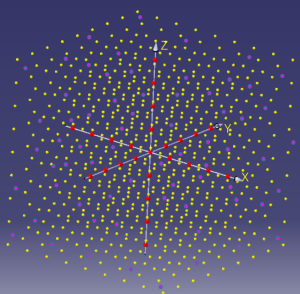
Fig.2 detection sample points(purple one)
Each detection sample point is combined with the force of three directions and the torque of three directions. The selection of detection sample points should meet the requirements of randomness and non-correlation, and be evenly distributed in the sample space, so as to evaluate whether the result of calibraion is good or bad.
In a word, compared with one-axisl force sensor, the workload of calibration and detection of six-axis force torque sensor is greater(fig.3), the requirement of equipment is higher(fig.4), the theoretical basis is deeper(fig.5)
これが今期の全内容である。高品質な力測定スキームをお望みなら、Kunwei Technologyにご注目ください。それではまた次回。
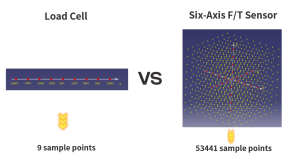
Fig.3 sample space comparison
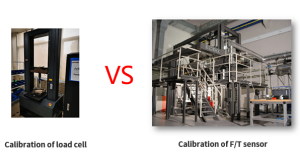
Fig.4
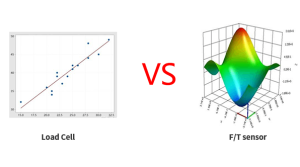
Fig.5
.jpg)