The zero clearing of six axis force sensor refers to the user specifying a state as the reference state of the sensor through commands or certain operations, and the sensor’s subsequent data is output based on this reference state.
For a six dimensional force sensor, this reference state is a set of data containing six component force information. For example, when a sensor is placed flat on a desktop, its output is a set of data that is close to zero in all directions. After installation, due to factors such as the end tool, its own gravity, and the angle of the installation surface, its data output is different from that on the desktop, and the force values in one or more directions may be much larger than zero.

In fact, it is easy to understand that users have such needs, because for an ideal sensor, we always hope that it is 0 before the action I am concerned about is generated, and the data increment after the action is generated is the force measurement value we want. But in reality, the sensor is not idealized. Its output is based on the zero position state at the factory, and it is not clear what state it is currently in, whether it is flat or side, so its output is not an ideal set of zero values in the user’s perception of the zero position state. So the user needs to specify a new zero position state, so that all sensor data is output based on this new state.
The reset operation of sensors is divided into two types: hardware and software:
Hardware reset is a command from the upper computer that requires the sensor firmware to remember the current measurement value as a reference value, and subsequent measurement outputs are based on this new reference value.
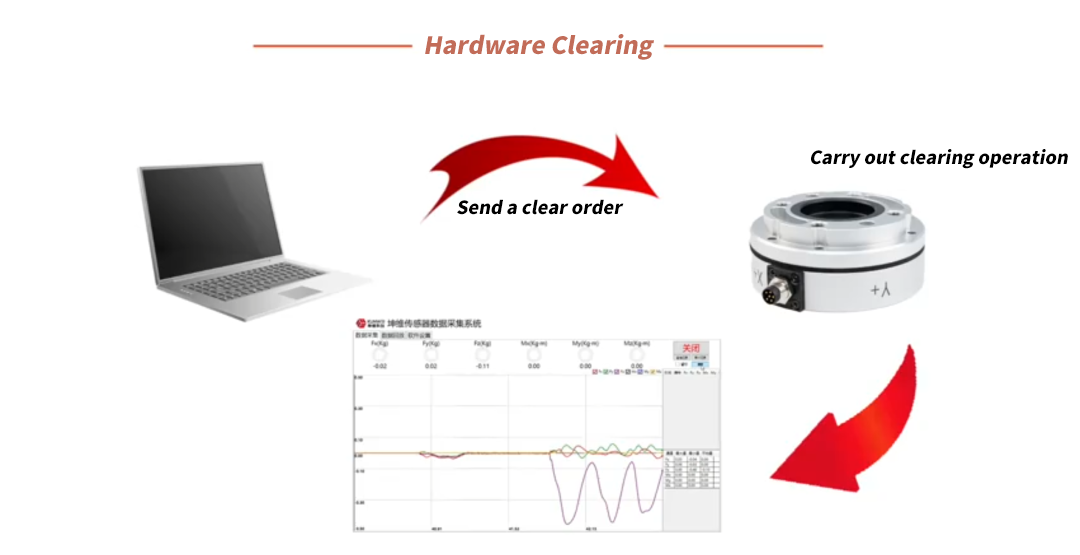
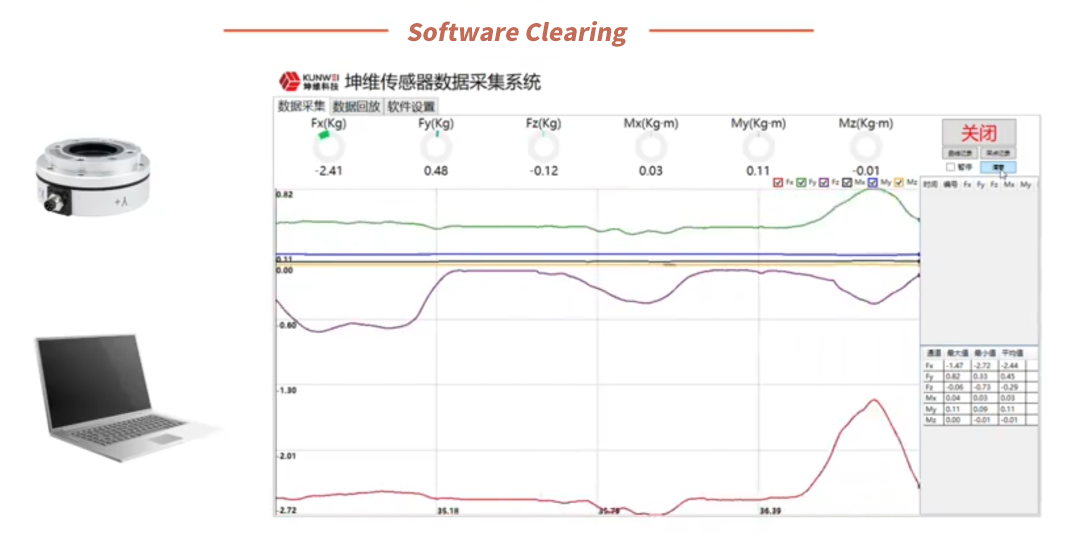
Kunwei Technology’s six axis force sensor currently does not provide a hardware reset command by default, unless the user deems it necessary to reset through the sensor firmware. We also recommend that users frequently perform software reset operations when using sensors, because the zero position state of the sensor is less affected by factors such as temperature in a short period of time, and the sensor data is always very accurate based on this zero position state. And the user is the operator of the entire actuator, very clear about the working status of the actuator, and can accurately specify a certain execution position as the zero position of the sensor. If users can frequently perform reset operations instead of only resetting once when powered on, the zero position of the sensor will not be affected by complex factors such as long-term temperature changes or changes in the status of the actuator, and the force information obtained by the user will always be accurate.

.jpg)